Japanese Cooking: A Simple Art
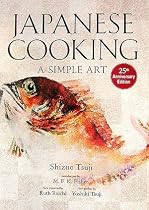
Japanese Cooking: A Simple Art
When it was first published, Japanese Cooking: A Simple Art changed the way the culinary world viewed Japanese cooking, moving it from obscure ethnic food to haute cuisine.Twenty-five years later, much has changed. Japanese food is a favorite of diners around the world. Not only is sushi as much a part of the Western culinary scene as burgers, bagels, and burritos, but some Japanese chefs have become household names. Japanese flavors, ingredients, and textures have been fused into dishes from a wide variety of other cuisines. What hasn't changed over the years, however, are the foundations of Japanese cooking. When he originally wrote Japanese Cooking: A Simple Art, Shizuo Tsuji, a scholar who trained under famous European chefs, was so careful and precise in his descriptions of the cuisine and its vital philosophies, and so thoughtful in his choice of dishes and recipes, that his words--and the dishes they help produce--are as fresh today as when they were first written.
The 25th Anniversary edition celebrates Tsuji's classic work. Building on M.F.K.Fisher's eloquent introduction, the volume now includes a thought-provoking new Foreword by Gourmet Editor-in-Chief Ruth Reichl and a new preface by the author's son and Tsuji Culinary Institute Director Yoshiki Tsuji. Beautifully illustrated with eight pages of new color photos and over 500 drawings, and containing 230 traditional recipes as well as detailed explanations of ingredients, kitchen utensils, techniques and cultural aspects of Japanese cuisine, this edition continues the Tsuji legacy of bringing the Japanese kitchen within the reach of Western cooks.
Product Details
Editorial Reviews
Amazon.com Review
Japanese food was virtually unknown in many Western cities in the 1980s, when Shizuo Tsujii wrote Japanese Cooking: A Simple Art. M.F.K. Fisher's introduction eloquently sets the stage for Tsujii's classic work. It may be the most thought-provoking piece ever written about Japanese food for non-Asians, pointing out how food and even the physical act of eating differ from what they are in Japan. Tsujii's writing is clear and educational. He talks specifically to a Western, non-Asian audience, demonstrating far more awareness of our culinary preferences and prejudices than most Westerners have for his. Following the preface (which should not be skipped), an arrangement of color photos of key ingredients and dishes sets the scene. Next, part 1 provides a thorough explanation of techniques for Japanese cooking and instructions for making all the basic elements of dishes. These "lessons" cover cutting vegetables, steaming, grilling, and deep frying the Japanese way, and even how to make sushi. Recipes cover Basic Vinegar Salad Dressings, Sushi Rice, and Teriyaki. To prepare Vinegared Octopus, a complete series of drawings clearly demonstrates each step.
Part 2 consists solely of recipes. Gather together fresh ginger, soy sauce, the sweet wine mirin , sake, and rice vinegar and you can make many of them. Beginners might start with Deep Fried Chicken Patties, Steak Teriyaki, Tortoise Shell Tofu, simply bathed in a tasty sauce, and Asparagus Rice, a light and colorful dish. Because of its combination of background information, comprehensive recipes, and excellent instructions, Japanese Cooking: A Simple Art will always remain an important book for learning about this simple yet complex cuisine. --Dana Jacobi
From Publishers Weekly
Easily the most comprehensive and exhaustive look at Japanese cuisine available, this groundbreaking classic marks its quarter-century anniversary in a revised edition with a new foreword by Gourmet editor-in-chief Ruth Reichl and a new preface by the late Tsuji's son, Yoshiki Tsuji. Part cookbook, part philosophical treatise, this highly acclaimed collection offers a wealth of insight for amateurs and experts alike. Every technique associated with Japanese food is described step by step in great detail, along with illustrations to guide the reader through everything from filleting fish or cleaning an octopus to rolling omelets. Sections on the Japanese meal, ingredients and selecting and cutting fish, chicken and vegetables offer great insight into the culture as well as the food. The recipe section of the book is divided by cooking method rather than food type, including grilled and pan-fried, steamed, simmered and deep-fried. Dishes range from the simple, Pan-Broiled Salmon, to the more complex, Nagasaki-Style Braised Pork, and many dishes are vegetarian. Sushi and sashimi are covered in depth, as are knives, the proper way to slice the fish, and decorative presentations. A complete guide to Japanese cooking, this collection is must-have for anyone interested in Japanese food or culture. (Apr.)
Copyright © Reed Business Information, a division of Reed Elsevier Inc. All rights reserved.
Review
"A wonderful book ... encyclopedic and easy to follow." -- Bedford Times
Customer Reviews
Best Japanese cookbook, but...
I was looking for a comprehensive Japanese cookbook that uses original ingredients (rather than what happens to be available in the West). This is the best Japanese cookbook from this perspective that I've seen. However, I still only give three stars, because being the best is not good enough.
I have not found a single comprehensive cookbook that fully uses Japanese ingredients. Many ingredients might not have been available in the West when the book was written (like wagyu beef), but they are now so the cookbook should cover them.
I suppose such a cookbook will be written during the coming decade, in the meantime I can strongly recommend this book. I don't think there is any better book when I'm writing this review. If you are aware of a better book, please let me know in the comments section below.
The Japanese Cooking Bible
What Julia Child's Mastering The Art of French Cooking was to the cuisine of France, so "Japanese Cooking: A Simple Art" is to Japanese food. This is the single-absolute-must-have book for anyone interested in cooking or even simply appreciating and eating the many delights and delicacies that come from this culinary culture.
Author Tsuji Shizuo doesn't simply want to teach you how to cook. He wants you to understand the thought process that goes into Japanese cooking, into the culture of food-lovers that produced one of the world's most delicious and diverse national cuisines. Starting with the ingredients, he walks your through all of the core items you will need, the flavors found within, how they can be combined and how they should be prepared. Everything that is touted in modern cooking: freshness, seasonal ingredients, food prepared to augment its natural flavor; it all comes from Japan.
Along with theory, this is a serious cooking manual as well. Cutting techniques, preparation styles, in-depth recipes for all major traditional Japanese foods; this is a classroom in a book. Along with the ingredient list there is also an explanation of traditional tools, and what can be substituted from what is commonly found in a Western kitchen. Knives get a lot of focus, as the standard Western knife set is designed for French cooking which has different demands than Japanese.
One thing this book is not is "food porn". There are no glorious and mouth-watering color photographs of the various recipes, no clever and cute names for dishes or original variations. The illustrations are all instructional in nature, with step-by-step processes to show you how to cut and stir to get the desired result. "Japanese Cooking: A Simple Art" is probably not for the casual fan who just wants something easy and quick. It is much more Anthony Bourdain than Rachael Ray.
But if you really want to master the art of Japanese cooking, then you need this book. It is that simple.
Lots of information about the culture of Japanese cooking; not merely a cookbook
I agree with all of the reviewers who cite the thoroughness and the attention to technique and to information on unfamiliar ingredients. I ordered the 1980 version by mistake, because it was so much cheaper. I really don't know if it is much different than the newer version, but somewhere I read that it hadn't been revised much. If I have any disappointment about the book, it is that there are very few pictures.
Related Links : Product by Amazon or shopping-lifestyle-20 Store