In Defense of Food: An Eater's Manifesto
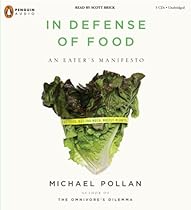
In Defense of Food: An Eater's Manifesto
What to eat, what not to eat, and how to think about health: a manifesto for our times.Product Details
Editorial Reviews
Amazon.com Review
Amazon Significant Seven, January 2008: Food is the one thing that Americans hate to love and, as it turns out, love to hate. What we want to eat has been ousted by the notion of what we should eat, and it's at this nexus of hunger and hang-up that Michael Pollan poses his most salient question: where is the food in our food? What follows in In Defense of Food is a series of wonderfully clear and thoughtful answers that help us omnivores navigate the nutritional minefield that's come to typify our food culture. Many processed foods vie for a spot in our grocery baskets, claiming to lower cholesterol, weight, glucose levels, you name it. Yet Pollan shows that these convenient "healthy" alternatives to whole foods are appallingly inconvenient: our health has a nation has only deteriorated since we started exiling carbs, fats--even fruits--from our daily meals. His razor-sharp analysis of the American diet (as well as its architects and its detractors) offers an inspiring glimpse of what it would be like if we could (a la Humpty Dumpty) put our food back together again and reconsider what it means to eat well. In a season filled with rallying cries to lose weight and be healthy, Pollan's call to action—"Eat food. Not too much. Mostly plants."--is a program I actually want to follow. --Anne Bartholomew
From Publishers Weekly
Starred Review. Pollan provides another shocking yet essential treatise on the industrialized Western diet and its detrimental effects on our bodies and culture. Here he lays siege to the food industry and scientists' attempts to reduce food and the cultural practices of eating into bite-size concepts known as nutrients, and contemplates the follies of doing so. As an increasing number of Americans are overfed and undernourished, Pollan makes a strong argument for serious reconsideration of our eating habits and casts a suspicious eye on the food industry and its more pernicious and misleading practices. Listeners will undoubtedly find themselves reconsidering their own eating habits. Scott Brick, who narrated Pollan's The Omnivore's Dilemma, carries forward the same tone and consistency, thus creating a narrative continuity between the two books. Brick renders the text with an expert's skill, delivering well-timed pauses and accurate emphasis. He executes Pollan's asides and sarcasm with an uncanny ability that makes listening infinitely better than reading. So compelling is his tone, listeners may have trouble discerning whether Brick's conviction or talent drives his powerful performance.
Copyright © Reed Business Information, a division of Reed Elsevier Inc. All rights reserved.
From The Washington Post
Reviewed by Jane Black
In his 2006 blockbuster, The Omnivore's Dilemma, Michael Pollan gave voice to Americans' deep anxiety about food: What should we eat? Where does our food come from? And, most important, why does it take an investigative journalist to answer what should be a relatively simple question?
In the hundreds of interviews Pollan gave following the book's publication, the question everyone, including me, asked him was: What do you eat? It was both a sincere attempt to elicit a commonsense prescription and, when it came from cynical East Coast journalists, a thinly veiled attempt to trap the author. "Oh! So he shops at farmers markets," we snipped enviously to one another. "Well, easy for him out there in Berkeley where they feast on peaches and cream in February! What about the rest of us?"
In Defense of Food is Pollan's answer: "Eat food. Not too much. Mostly plants."
For some, that instruction will seem simple, even obvious. (It will seem especially so to those who read Pollan's lengthy essay on the same topic in the New York Times magazine last year.) But for most people, those seven little words are a declaration of war on the all-American dinner. Goodbye, 12-ounce steak. Instead, how about three ounces of wild-caught salmon served with roasted butternut squash and a heap of sautéed kale? For many, following the rules may not be so simple after all.
Yet in this slim, remarkable volume, Pollan builds a convincing case not only against that steak dinner but against the entire Western diet. Over the last half-century, Pollan argues, real food has started to disappear, replaced by processed foods designed to include nutrients. Those component parts, he says, are understood only by scientists and exploited by food marketers who thrive on introducing new products that hawk fiber, omega-3 fatty acids or whatever else happens to be in vogue.
Pollan calls it the age of "nutritionism," an era when nutrients have been elevated to ideology, resulting in epidemic rates of obesity, disease and orthorexia, a not yet official name for an unhealthy obsession with healthy eating. "What we know is that people who eat the way we do in the West today suffer substantially higher rates of cancer, cardiovascular diseases, diabetes, and obesity than people eating any number of different traditional diets," he writes. "When people come to the West and adopt our way of eating, these diseases soon follow."
Part of Pollan's answer to improving our health is going back to traditional foods and ways of eating: Eat leaves, not seeds. Steer clear of any processed food with a health claim. And for goodness sake, don't eat anything your grandmother wouldn't recognize as food.
But equally important is changing the way we relate to food. Pollan argues that we've traded in our food culture -- a.k.a. eating what Mom says to eat -- for nutritionism, which puts experts in charge and makes the whole question of what to eat so confusing in the first place. Indeed, Pollan makes a strong case that the "French paradox" -- the way the French stay thin while gobbling triple crème cheese and foie gras -- isn't a paradox at all. The French have a different relationship with food. They eat small portions, don't come back for seconds and spend considerably more time enjoying their food -- an eminently sensible approach.
In Pollan's mind, trading quantity for quality and artificial nutrients for foods that give pleasure is the first step in redefining the way we think about food. The rules here: Pay more, eat less. Eat meals, not snacks. Cook your own meals and, if you can, plant a garden.
Each of the rules is well supported -- and only occasionally with the scientific mumbo-jumbo that Pollan disparages. But what makes Pollan's latest so engrossing is his tone: curious and patient as he explains the flaws in epidemiological studies that have buttressed nutritionism for 30 years, and entirely without condescension as he offers those prescriptions Americans so desperately crave.
That's no easy feat in a book of this kind. What should we eat? The answer is here. Now we just have to see if Americans are willing to follow good advice.
Copyright 2008, The Washington Post. All Rights Reserved.
Customer Reviews
opened my eyes
This book really opened my eyes to reasons why no "diet" I had tried ever worked. The way Pollan presented all of the research that had failed, then was swept under the rug by both the government and the food industry because it was not in either of their interests for that information to come out was easy to understand, and easy to come to the conclusions that Pollan has drawn. It is sad that the many people who did attempt to put out the research before were not capable or forgotten. I think that going back to a more antiquated style of eating, in both form and substance, is something all Americans need to do. We have not been eating food for many years, but "food," and that needs to change.
Good book, could be half as long
I have read a handful of books about food and diet. I may not be the target for this book. I'm skinny and eat mostly non-meat food anyways.
It is an interesting book, but I actually found myself zoning out, skipping paragraphs, then pages, then a whole section at the beginning. I already think our processed food culture is messed up, and he does go on and on about that if you need to be convinced. It is best when he references a specific study or the history of how grain was processed.
The author also rehashes the same points over and over again, and then at parts even summarizes what he will talk about in the next chapter. Reminds me of one of my papers from high school where I was trying to fill pages.
So far I found other books like "Healthy at 100" to be far more inspiring, engaging and informative.
My rating is a bit harsh probably, and I can see for some readers this being a great book on the topic of food and diet. It is an important issue that we will face more and more.
One of Us...One of Us..join us..forever and...ever
I have to say I'm prejudiced towards this kind of book that offers the reader a "lifestyle". With that said, I probably follow a lot of the ideas in the book, but I didn't have to read the thing to come to obvious conclusions like eating fewer portions of food will make you thinner. Really? Processed food is bad for me? Wow, I've been living a lie.
Though it won't explain how some people live healthy and long lives and they eat crap, drink too much, and smoke.
I'm impressed with the way these books tend to spread through the NPR-New Yorker crowd and make everyone jump all over themselves with enthusiasm. I heard Pollan on NPR and it seemed that his "wisdom of the grandmother" was a little too wistful and a bit false.
My grandmother smoked like a chimney and boiled the hell out of everything that she cooked, draining most of those nutrients out the door. Maybe if I had super-Oma or idealized nanna, she might have opened the oracle and showed me the way to live better and not be so nasty.
We eat differently than people two generations ago. To compare they way we eat to the way they ate is loaded with comparisons that don't make much sense because the conditions are much different. Processed food was not nearly as pervasive as it is now.
After reading the Jungle, I don't think anyone is going to make the case that sausage from a local company counts as "good honest" food compared to the way that some larger companies load their meats up with preservatives and fillers. Given a choice between a rat or some guy's finger and MSG, I think I'll go with the MSG.
It will be interesting to see what the next fad will be. Maybe it will be that processed food is better for us. I can't help thinking about that scene in Woody Allen's now dated film Sleeper, where a man wakes up in a totalitarian future to find two people trying to explain what his "health food store" was all about while they explain that smoking was found to be healthy and red meat was also good, especially when it's fried.
Related Links : Product by Amazon or shopping-lifestyle-20 Store